Saturday, September 06, 2008

QUALIS ARTIFEX PEREO & QUALIS ARTIFEX PEREO - FINIS


+
Martin Bladh & Bo I. Cavefors
QUALIS ARTIFEX PEREO
samt
QUALIS ARTIFEX PEREO - FINIS

Förord: Den färdiga actionfilmen QUALIS ARTIFEX PEREO skiljer sig från manus vad gäller medverkande. Därmed förändrades i viss mån själva agerandet. I filmen medverkar endast Bo, Martin, Erica, Johanna och Mikael.

Inspelningen av QUALIS ARTIFEX PEREO - FINIS skedde med här nämnda medverkande.

+ + +

QUALIS ARTIFEX PEREO
Medverkande: Bo, Martin, Erica, Johanna, Mikael, X, Y.

Akt 1.
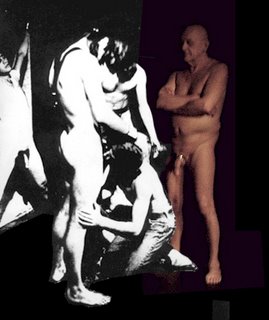
Bo, när spelet börjar: står mot en vägg med ryggen mot publiken, iförd vit vid sommarskjorta, inga byxor. Tar av sig skjortan. Publiken naken eller klädd i svarta kläder, dock: Jakob med naken överkropp och svarta byxor eller helt naken, Martin naken (endast iförd en suspensoar med intorkade blodfläckar), Erica naken med stövlar, dessutom tre eller fem personer. Orgelton. Bo, ”frånvarande, drömmande”, har ena handen mot anus, ett par fingrar inne i anus, andra handen runt kuken. Ett mycket långsamt "uppvaknande", olika ställningar. Bo oljar in anus och kuken med olja som finns i en njurformad metallskål. Ena handen alltmer agerande i anus och med den andra handen ett synnerligen långsamt runkande (tio minuter). Martin döljer sin kuk, som ett sår, bakom sin högra hand. Neros ord (på latin, engelska och svenska) ropas ut av samtliga närvarande i rummet (ej av Bo och Johanna).

Ett noisemusik-collage av Martin. Kaganof klipper in ett bildspel, stillbilder/rörliga bilder från slakthus, avrättningar, tortyr, brottsplatser, religiösa ceremonier, helgonbilder/ikoner, Acephale.


Akt 2.
En strålkastare lyser upp Johanna som sitter svartklädd, benen korslagda, på en stol längst ned i lokalen, på avstånd från Bo, men Bo närmar sig henne ibland med sitt agerande. Orgelton, högre pitchad än i akt 1. Johanna läser Bataille/Bladh-texten. Varje gång hon når de partier som Martin skrivit förvrängs rösten (Mikael sköter ljudet). När Johanna nått igenom halva texten stannar hon upp. Samtidigt: Bo reser sig upp, börjar agera med livremmen, intar "vulgära" ställningar, går fram mot publiken, tar på publiken, suger och runkar de som är nakna, slickar och smeker med handen ömt och hängivet Y:s Acephale-tatuering (se likhet med Neros ”lekar” och Pasolinis Salo). Martin runkar tafatt, impotent. Neros ord (på engelska och latin) ropas ut av samtliga närvarande i rummet (ej av Bo och Johanna).

Ett noisemusik-collage av Martin. Kaganof klipper in ett bildspel, stillbilder/rörliga bilder från slakthus, avrättningar, tortyr, brottsplatser, religiösa ceremonier, helgonbilder/ikoner, Acephale.


Akt 3.
Johanna fortsätter att läsa Battaile/Bladh-texten (varje gång hon når de partier som Martin skrivit förvrängs rösten) omväxlande med att Liberty-texten upprepas stötvis. Orgelton, högre pitchad än i akt 2. Samtidigt: Bo utnyttjar "trappstegen" i den svarta salongen för att visa anus, går fram mot publiken, och visar fram kuken och anus, piskar och smeker sig själv. Stannar framför X, suger, kysser och kramar honom – förälskelse. Därefter visar Bo bara upp sig (avsikt: att få publiken kåt utan att något sker). Bjuder ut sig åt publiken. De av publiken som vill inbjudes att knulla, suga av eller piska eller smeka honom. Johan tar över agerandet, ”förför” Bo, koncentration till Bos anus som visas upp. X knullar Bo. Samtidigt: Bo onanerar allt våldsammare, Martin runkar impotent/tafatt, men nu snabbare/våldsammare. När X knullat Bo och tömt sig inne i honom, med sperma kvar runt anus (närbilder), lämnar Bo över livremmen till Martin, som piskar Bo. Martin lämnar över livremmen till Y, som piskar Bo. Y lämnar över livremmen till Erika, som piskar Bo, som då ejakulerar. X vilar ut vid sidan om Bo, håller ömt en hand runt hans nacke. Y eller Martin häller blod från en njurformad metallskål över Bo. Martin och Y tecknar med blod, religiösa tecken, som kors, på Bos kropp. Bo lägger sig på rygg, drar upp benen och visar åter anus. Närbilder av anus. Kaganofs kamera går allt djupare in i anus tills det bara blir ett svart hål – en bild av solen. Neros ord ropas ut av samtliga närvarande i rummet (ej av Bo och Johanna). Engelska och latin. X finns kvar under hela slutsessionen.

Ett noisemusik-collage av Martin. Kaganof klipper in ett bildspel, stillbilder/rörliga bilder från slakthus, avrättningar, tortyr, brottsplatser, religiösa ceremonier, helgonbilder/ikoner, Acephale + bilder av solens yta, solstormar etc.

+ + +

Texten, av Georges Bataille och Martin Bladh (kursiv text), som läses av Johanna:

När mitt ansikte fylls med blod, blir det rött och obscent. Det förråder samtidigt, under förvridna reflexer en blodig erektion och en oumbärlig törst för oanständighet och kriminell sedeslöshet.

Av denna orsak avskräcks jag inte att hävda att mitt ansikte är skandalöst och att min passion endast kan yttra sig genom JESUVET.

Det världsliga klotet är täckt med vulkaner, som tjänar som dess anus. Trots att detta klot inte äter någonting, slungar det ofta ut sina tarmars innehåll.

Innehållet som skjuts ut med oväsen och faller tillbaka, strömmar ned längs Jesuvets sidor, sprider död och förintelse överallt.


Djurlivet i sin helhet kommer ur havets rörelser, och inifrån kropparna, fortsätter livet att komma av saltvatten.

Havet, har spelat rollen som det kvinnliga organet som fuktas under penis retning.

Havet runkar av kontinuerligt.

Solida element, som inhyses och frodas i vattnet väcks till liv av erotisk rörelse; slungas ut i form av flygande fisk.

Erektionen och solen chockerar på samma vis som ett kadaver och källarens mörker.

Vegetationen är enhetligt riktad mot solen; människor, erigerade likt träd, skyller trots sin uppenbara olikhet med djuren, även de av nödvändighet sina ögon.
Det mänskliga ögat tolererar varken sol, coitus, kadaver eller det obskyra, men reaktionen är av en annorlunda natur.

Tallkottögat, som särskiljer sig från det horisontala systemets normala okulära syn, uppenbarar sig således i en slags tårfylld nimbus, likt ett träds öga eller, möjligen, ett mänskligt träd. Samtidigt är detta okulära träd inget mer än en väldig penis, som under solens berusning vittnar om eller påkallar ett vämjeligt illamående, en kväljande ångestladdad svindel.

Enligt denna naturens omgestaltning, under vilken synen i sig, attraherad av det vämjeliga, dras ut och slits sönder av solflammorna som den stirrat in i, slutar erektionen sin smärtsamma omvälvning på jordytan och i en uppstötning av smaklöst blod, förvandlas den till ett svindlande fall genom den världsliga rymden, åtföljt av ett fruktansvärt skri.

Att vara medveten om världen och lemmarnas organiska puls.
Ständigt närvarande i köttet: blod, märg, slem.
Buken pressar mot marken, pryglar den nakna jorden.
Rygg och måltavla ständigt utelämnad åt ers nåd: vråk, hyena.

MODERGAM
MODERSCHAKAL

Din grymhet gödde mig: din livsfrukt.
Det som står till svars inför mig; mitt kött och livsgärningar.
Ditt avträde.
Din livsfrukt.
De fria lemmarnas krig;
ett organens anarki, vrålet efter vedergällning och utlösning.

MODERGAM
MODERSCHAKAL

Jag håller eggarna
Jag pekar dem mot dig
Jag för dem tillbaka upp genom dig
Jag möter motståndet inuti dig,
tillbaka in genom grymheten;
den farsot som gödde mig.

Solen, benägen på himlavalvets botten likt ett kadaver i avgrunden, besvarar detta omänskliga skri med förruttnelsens spöklika attraktion. Den överväldigande naturen bryter sina bojor och kollapsar inför det obegränsade tomrummet. En avskuren penis, mjuk och blodig, är substitut för tingens invanda åtgärder. Inom dess ramar, där smärtfyllda käftar fortfarande biter, var, spott, och enorma flugors larvägg frodas: exkrementalt likt ögat som målats på botten av en vas, lånar Solen sin strålglans i döden, begraver existensen i den stinkande natten.

Det världsliga klotets storhet kan liknas vid en kal skalle, från vars mitt det vulkaniska ögats påle öppnas upp mot himlen. Det breder ut sitt katastrofala landskap ned i det håriga veckade köttet, och håret som formar dess buske är översvämmat med tårar. Men förfallets upprörda känslor, främmande som självaste döden, har inte sitt ursprung i en ordinär hjärna: tunga inälvor pressar i ensamhet detta nakna kött, lika laddat med obscenitet som en bakdel – lika satanisk som den likaså nakna stjärten som en ung besvärjerska reser mot den svarta himlen i samma ögonblick som hennes fundament öppnas, för att mottaga den flammande facklan.

Kärleksvrålet som slits ur denna komiska krater är en febrig snyftning, en alarmerande åskknall.

Solens exkrementala öga har alltså befriat sig från dessa vulkaniska inälvor, och smärtan hos en man som sliter ut sina egna ögon med fingrarna är ej mer absurd än solens anala moderskap.

Kärlek, skriker då ur min strupe; jag är Jesuvet, den smutsiga parodin på den heta och bländande solen. Jag vill få strupen avskuren medan jag skändar flickan till vem jag fått tillfälle att säga: du är natten.

Solen älskar uteslutande natten och riktar sitt flödande våld, sitt skändliga skaft, mot jorden, men finner sig inkapabel att nå varken blicken eller natten, även då nattens världslighet kontinuerligt vidgar huvudet mot den skändliga solära strålningen.

Solar annulus är hennes kropps intakta anus vid 18årsålder mot vilket inget, undantagsvis solen är tillräckligt bländande, även då anus är natten.

Jag skiter ned mig i solen imorgon, öppen – naken med skuld.
Sedan impotens, fortsatt förlust – triumf eller förtvivlan?
Är detta vad allt handlar om;
Negation? Inversion? Fascination? Terror? Njutning eller tortyr?
En ekonomisk skuld.
Profit/förlust,
spendera/inkassera,
förlösning/utlösning.
Varför blir dessa fotografier och videoband min spegel?
Varför denna vackra förpackning; intakta vägg av kött och ord?
Brustna ådror, O-kompletta meningar synbara genom huden.
Så vad får dessa ord att bli sanna?
Så vad är egentligen en upplevelse?
Ett altare, det olycksbådande verk som rests i mitt badrum?
Ett gömt lönnfack bakom bokhyllan i mitt vardagsrum?
Konturerna av mitt ansikte, lår händer och skrev?
Vid brantens rand…förbrännas, upplösas på samma sätt som dessa fotografier framkallades.
Vid brantens rand…suddas ut, leva dessa ord; ta dem på mig, bokstavligen.
Vad jag gör blir slutgiltigt; en outtröttlig process; en privat implosion av överflödiga ord, av ständigt upprepade bilder.

Nära en rund grop, nyligen grävd i den frodiga vegetationen, kämpar en långarmad aphona med tre män, som binder henne med långa rep: hennes ansikte, lika idiotiskt som det är gement, släpper ut fruktansvärda skrik av fasa, skrik som besvaras av andra tjut från mindre apor i det höga grenverket. Sammanbunden som en kyckling – med benen bakvikta mot kroppen - binder de tre männen henne runt en påle som rests i gropens mitt. Fastbunden på detta vis, sväljer hennes monstruösa ylande mun jorden, medan den andra sidan, hennes enorma vrålande rosa analöppning stirrar upp mot himlavalvet likt en blomma: endast delen vars obscenitet överväldigar är synlig över gropens kant.

I den absurda himlens tomrum, spydde solen som ett sjukt fyllo över munnar fyllda med kosmiska skrik...Och så förenar sig hettan och omtöcknaden i en allians – lika överskridande som tortyr: som en avskuren näsa, som en utsliten tunga – de firar ett bröllop (firade med rakbladets egg mot näpna, oförskämda små stjärtar), denna lilla kopulering mellan det stinkande hålet och solen...

Jorden, skakad i sina grundvallar, besvarade naturens tvivelaktiga kolik – utlöste, i skogarnas klibbiga halvskugga, genom oräkneliga köttblommor – med den högljudda glädjen av inälvor, med kräkningar från otroliga vulkaner. På samma vis som ett plötsligt skratt utlöser andra, eller en gäspning utlöser gäspningar bland en folkmassa, har en burlesk exkremental kramp släppts lös, en krampaktig eld, under en svart himmel härjad av åska. I detta underland, bryter en vind, tyngd med blodig rök, då och då ned enorma glödande träd, medan floder av pryglande rödglödgande lava strömmar fram överallt, som från himlen. Med köttet på halster, med munnar förvridna i infantila skrin, flyr de stora aporna, offren, undan denna vansinnes tortyr.

Flera av dem fälldes och klämdes skrikande fast på rygg eller mage, under brinnande trädstammar; de fattade snart eld och brann som fnöske. Emellanåt, hände det, att några enstaka som hamnat på en trädfri strand, räddades undan lågorna, skyddade från röken av en motvind: de var dock inte mycket mer än utmattade sår, oformliga silhuetter, halvförtärda av elden, som tog sig upp eller låg kvar och gnydde på marken, ragglandes i fruktansvärda plågor. En kaskad av röd lava – mardrömslikt bländande – en apokalyptisk lava som verkade blödas ut ur deras egna anus (precis som deras egna håriga kroppar ursprungligen hade visat, och enligt sadistiskt manér stuckit fram sina vidriga anus – som för att skända och förolämpa existensen). Dessa olyckliga varelser blev i likhet med kvinnans fruktbara livmoder, någonting fruktansvärt...

Likt rovdjur sliter ni sönder min oskyddade muskelvävnad,
mal den mellan rakbladständer,
suger näring ur märg och blod,
för att slutligen svälja ner mig i ert uttänjda innanmäte.

Öppna ert universum av röda implosioner,
maligna undervattenstumörer,
låt dem svälla och föröka sig i den fertila myllan.
Jag er outvecklade livsfrukt,
Jag ert stympade krymplingsväsen,
Jag som delvis undkommit urmoderns käftar,

låt mig sakta upplösas i er gigantiska apparat,
låt mig smekas av tarmtrådar och enzymer
på väg mot slutstationen
på väg mot undergången

låt den yttre världsbilden avlägsnas
länken: den evigt uppstående,
reser sig ur sitt predestinerade stålbad
Svärdet, Lemmen, Armen,
jag för er tillbaka in i skapelsens svällande kötträdgårdar.

Ögat på toppen av huvudet, öppnar sig mot den glödande solen för att skåda dess ödesdigra ensamhet, är inte sprunget ur förnuftet, det är en omedelbar existens, som öppnar och bländar sig självt likt en eldsvåda, likt en feber som äter varat, eller mer precist, huvudet. Det fungerar som ett brinnande hus; där huvudet, istället för att låsa in livet som pengar i ett kassaskåp, spenderar dem urskillningslöst, för att vid slutet av den erotiska metamorfosen, ha tagit emot den elektriska kraftens udd. Detta enorma brinnande huvud är bilden och det motsägelsefulla ljuset av utgiftens föreställning, omsorgsfullt utarbetat enligt den metodiska analysens basis bortom den fortfarande tomma förbrukningens föreställning.

Ursprungligen identifierades myten inte enbart med livet utan med dess avsaknad – med förfall och död. Det börjar med varat som bar den inom sig, det är inte alls en extern avkomma, utan den manifestering som det flytande varat intar i hans egen gestalt; med denna extatiska gåva gör han sig själv till ett obscent naket offer – inte ett offer inför en obskyr och immateriell kraft, utan inför skrattet från vrålande horor.

Existensen påminner inte längre om en detaljerad linje som leder från en punkt till nästa, utan istället om en sjuklig glöd, en bestående orgasm.

All jordens plantor reser sig mot himlen, och slungar kontinuerligt ut myriader glänsade spottstrålar mot solen i form av blommor, och enbart en obscen Van Gogh, omgiven av galningar kan slunga sina ögons falliska lorska mot samma sol. De andra människovarelserna släppar runt som stora erigerade impotenta fallosar, med ögonen fastlåsta på den sövande omgivningen.

Det är nödvändigt att bryta upp sig själv i bitar och känna vansinnet slingra sig i kroppen; samtidigt måste man bli fetischist på gränsen till slav, en ögonfetischist, en fetisch för skinkor och fötter, allt i ett, för att i sig själv kunna återväcka vad som olyckligtvis aborterades i den ursprugliga människokroppens konstitution.

Anus kala höjd har blivit centrat, svärtat av buskage, på den trånga ravinen som klyver skinkorna.
Den spöklika manifesteringen av denna teckenförändring representeras av en främmande mänsklig nakenhet – nu obscen – som är substitut för den håriga djurkroppen, och speciellt av pubishåret som uppstår på exakt samma ställe som apan var hårlös; omgiven av en dödsgloria, en varelse som är för blek och för stor står upp, en varelse som, under en sjuk sol, inte är någonting annat än det himmelska ögat det saknar.

Som universums medelpunkt kommer mitt kött att förtäras av er hunger:
fäder, mödrar, söner, döttrar.
Jag är obegränsad.
Jag finns till för er alla.
Svarta och livlösa ser mina svarta dockögon ner på er från den helgade platsen ovanför altartavlan.

Mitt kall innebörden av mina gärningar och dagliga iscensättningar.

Ett kött av oändliga möjligheter och uttrycksformer.
Hur jag fann mig själv – Länken: Logos.
Hur ni hörde kallet, tog mig i er famn.
Bar mig till altaret och reste mitt podium.
Allt är nu väldokumenterad historia.

+ + +

QUALIS ARTIFEX PEREO - FINIS

Medverkande: Bo, Martin, Johan, Mikael

Ett kvadratiskt eller rektangulärt rum.

Mot väggen projiceras Martin Bladhs videoverk Injury, 21 min, tre delar. Handlingen kretsar kring sexuellt utnyttjade pojkar som i vuxen ålder blivit förövare (actionmotiv: offer/förövare). Filmen har en mycket påträngande stroboskopeffekt, som höjer aktionens intensitet ytterliggare. Endast filmens malande monotona monologer är hörbara (en förvriden androgyn röst). Filmen spelas upp två gånger under aktionen. Aktörernas agerande följer filmens monologer.

Framför väggen sitter Martin naken (endast iförd en suspensoar med intorkade blodfläckar) på en regissörsstol, armar och ben sammanbundna på ryggen. Repet binder även samman Martin med stolen. Repet slås även runt Martins kuk. Blicken fäst vid golvet. Skamsen. Men sneglar under actionens gång på Bos och Johans ageranden.

På golvet framför stolen (rummets mitt) ligger Bo, naken i korsformation. Svart huva över huvudet. Vid hans fötter på en vit trasa med intorkade blodfläckar, en skalpell, en livrem, och ett litet metallfat med tändstickor och cigaretter. På vänster respektive höger sida om honom ett njurformat metallfat fyllt med människohår. På golvet ovanför Bos huvud (mellan Martin och Bo) står en tredje metallskål, även den fylld med människohår.

Mikael, iförd en vit skyddsoverall och blå plasthandskar, står med ansiktet vänt mot rummets vänstra vägg.

Bo och Johan har före föreställningen rullat sig i grus eller liknande, så att de är smutsiga, otvättade.

Johan, naken, står vid den högra väggen (mitt emot Mikael).

Publiken står utmed rummets tre väggar, dvs Mikael och Johan står tillsammans/mitt bland publiken.

Efter ca 10 min börjar Bo att onanera, liggandes, använder kroppsoljan, smetar in sig, fokus: anus och kuk. Samtidigt onanerar Johan, tänder en cigarett, röker njutningsfullt och tittar på Bo.

Mikael tänder på innehållet i skål 1

Bo reser sig efter 22 min (filmen har tagit slut och börjar om från början). Mikael drar av honom huvan, går bort till Martin på stolen och drar den över hans huvud (motiv: offer-identifikation med bödel).

Mikael tänder innehållet i skål 2, och går sedan tillbaka till sin utgångspunkt vid den vänstra väggen.

Johan och Bo smeker och kysser varandra över hela kropparna. Runkar varandra, suger varandra, osv. Johan fimpar aska på Bo. Johan släcker sin cigarett på Martins rygg. Återvänder till Bo och agerar sexuellt häftigare än tidigare.

Mikael tänder på håret i skål 3.

Johans och Bos sexuella aktiviteter blir livligare, hårdare. De piskar varandra med livremmen, sadistisk lek. Bo går fram till Martin och ger honom fem hårda rapp med livremmen. Bo slänger livremmen på golvet. Johans och Bos sexuella lekar blir aggressivare, de brottas (Bacons/Muybridges Brottare), de smörjer in varandra med olja. Johan knullar Bo, båda ejakulerar. Samtidigt går Mikael fram till Martin och skär ett djupt snitt i hans högra sida med skalpellen. Mikael skär sönder suspensoaren, river den i bitar, slänger delarna på golvet. Smeker bort blodet med handen, kysser såret, blir sittande vid Martins sida. Mikael reser sig, skär loss Martin från stolen. Bo och Johan ligger kvar, utmattade, kysser varandra.

Filmen slut, Martin och Mikael lämnar scenen. Bo och Johan ligger kvar.

+ + +

Appendix: INJURY

1
1:1
In spite of everything I was smiling when I was little. I can tell from photos. But inside I felt bad . It’s like I had two personalities. On the outside I was a good little boy, steady, good at school . Inside, I felt different from the others. I was apprehensive.

1:2
I was often in tears because of the fights at home. My mother used to say that boys don’t cry. To punish me she would stand me in front of the mirror, while she humiliated me in front of my brothers and sisters, she would say: “Look at that cry baby, see how you look! You’re not even a man, you’re nothing but a scared cat…” There was no tenderness or love in our house. Not for me anyway. My mother was sounding off all the time. I never could do anything right as far as she was concerned.

1:3
One day we had visitors at home, I had to sleep on the sofa in the living-room and let someone else have my bed. That’s when it all began. I was sleeping on my stomach, in my underwear. Half asleep, I felt someone come up behind me, pull down my shorts, and penetrate my rectum. I was so afraid that i didn’t dare to turn over. I could hear his heavy breathing, feel his breath, but I couldn’t see him. I believe it was my father because I knew how he smelled, how big he was. I had no idea what to do, what to say. I hurt all over. I was bleeding from the rectum. The next day I stayed in bed, I couldn’t stop bawling. For a long time after that, whenever I got nervous, I would mess in my pants. Maybe it was a physical problem because of the dilated rectum, perhaps it was psychological. I don’t know, but I had the problem for years.

1:4
What my brothers asked me to do was disgusting. I don’t know where on earth they got such ideas. One of them urinated in my face. Another time he shat on me. He was laughing, he found it amusing. I was crying and I ran away from them. A bit later my oldest sister asked me to have sex with her. She was laughing at me because I still didn’t have erections. She said I had a small penis. It felt ill at ease. I find it hard being humiliated.

1:5
For a few years, I admit, I didn’t question what was going on, but when I was about twelve or thirteen I often thought about what was happening and wondered about it. I compared myself to others and realised I wasn’t normal. When I might have wanted to talk about it, I figured that nobody else talks about anything, so why should I?

1:6
Around the age of eleven, I started hitch-hiking on the big highway. I was looking for attention, for affection. Anybody would do. Sometimes cars would stop an pick me up. I didn’t dare to say no when they asked me to fellate them. First, they would touch me, checking me out to see how I would react. When they could see that I appeared to be okay with the idea, that I wouldn’t make a fuss, they would pull over and stop further on. They would do what had to be done in the woods or in a field.

1:7
I don’t want to be with anyone, man or woman, who would want sex with me, when someone seems to be interested in me, I imagine it’s just for sex. I would like to meet someone, but I can’t get away from the idea of abuse, the fear of sexuality. I am not used to receiving pleasurable caresses. I fell bad when someone touches me. A person who touches me disgusts me. And sperm, even my own, I find disgusting. I don’t like kissing on the mouth either.

2
2:1
I don’t like my body. Maybe it’s because I haven’t appreciated the sexual relationships I’ve had. I’d like to have a different body, a complete makeover so I can say I’m starting my life over from zero.

2:2
I would have liked to have a girl interested in me, but I didn’t attract girls. I must admit I wasn’t comfortable too with myself. I was full of complexes, fears, and sensitivities. My brothers were making fun of me because I still wasn’t ejaculating at the age of eleven. I was wondering how to go about getting involved with girls.

2:3
Men, they’re always ready for sex, and afterwards it’s like “Don’t know him, never seen him”. If I went about it the same way with a girl as I do with men, she’d think I was a sex maniac. My favourite trick is to wait in the park or in a public toilet until a man comes in. Then, if he hangs around, it he’s looking at me… there are lots of ways to tell if he’s interested… and since I’m quite good looking…

2:4
What excites me is a sense of danger. I get a thrill out of it. Actually, men probably excite me less than the context in which things are happening. Getting it on with a guy, undisturbed, in a bedroom, with a little background music playing, that’s okay for homosexuals. But that doesn’t interest me. What I want is the risk, the fear of being found out, being surprised.

2:5
I like to masturbate. Like to play the exhibitionist, too. I’ve done that since I was a teenager, I’ve been arrested by the police for it. It always happens in a special context. When I’m drunk, on drugs, something inside me wakes up. I stand outside a house, in the garden , in front of peoples windows and show myself off. Then I masturbate, sometimes even ejaculate in front of them. It’s always women, just women. In the beginning I used to leave the windows and curtains open at home and parade about in the nude. I liked the turn-on. Then i went out to do it. I found that even more exciting.

2:6
I put on a tough front. People think I’m hard but I’m just acting a role, like in a drama. I identify to great extent with Jim Morrison of the Doors. I would love to write music and write like him. The essential is that I will have to be myself. But it’s though I no longer have an identity, that I’ll have to glue on one, so to speak. I do have a made-up identity, but it’s only a role I play.

2:7
Ideally, I would like to find myself on my own in a place where everything is beautiful and pure, where everything that happens is agreed upon. There at least I could be with someone without risk. I am bisexual, perhaps, but I don’t want sex.

3
3:1
A homosexual picked me up and took me in. After a few days, he asked me to have sex with him. I didn’t say no. Having sex had become a habit for me. I no longer even asked myself if I preferred males or females. I don’t consider myself a homosexual: in my fantasy life I prefer women and children.

3:2
I must admit I’ve had fantasies about younger boys also. At a certain point I had a dream: I was abusing a young fellow the way I was abused. That’s really not my thing. I reacted badly. It was as though I’d been hit on the head with a sledgehammer. I thought of killing myself. I cut my veins. But I stopped in time. This went on for about eight or nine months. I said to myself: If I’m capable of doing it in a dream I could do it awake. But I don’t want to be involved with young boys. I’m in therapy for that. I try not to think of the past. It’s like putting on a suit of armour. I’ve had other similar dreams recently, with girls in the dreams too. I wake up and feel excited. But now, instead of panicking, I try to make connections. I ask myself what happened the day before to make me think of that. I keep a journal to help me understand, to make connections between it all.

3:3
When I had homosexual fantasies I couldn’t control, I had the idea of hiring a male prostitute. At night, I would cruise the streets where they hang out. A prostitute was abetter solution, less distressing for me. The prostitute was okay with it and after, for me it was out of sight, out of mind. I wasn’t accountable to anybody.

3:4
To me they’re all sluts, like my mother. When I make love, you know, I’m a very gentle fellow. With certain women some vengeance will surface, but not with all. Most of the women I made love with were not aware of what was going on inside me.

3:5
As an adolescent, began to cut me myself, to carve into my arm because I was mad at myself. I wasn’t unable to express my violence except against myself. I had other problems. I had begun to masturbate more or less anywhere, openly, in the classroom, on the bus. It was like an experiment for me. I was putting objects into my rectum too. That way, I wasn’t hurting anyone else. I find it difficult to accept my sexuality.

3:6
The first time a masturbated on a child was when I was babysitting the daughter of one of my brothers. She must have been about two or three. I took off her diaper and rubbed my penis against her private parts. I didn’t want to penetrate her, just to feel her next to me. I did it again a few more times before I began to be afraid of what I might do. I stopped. I realised I wasn’t normal. To put it out of my mind I used to drink. I was taking pills, taking drugs. Perhaps it was the softness of the baby that attracted me to her. Still today, with women, I never feel completely satisfied sexually. It is children who excite me the most, although I don’t want to touch them, anymore.

3:7
I have violent thoughts about buying weapons and getting some revenge. I know there’s something missing, something dead inside me that I’ll never get back. I rail against this. But you know, when I was little, I was a romantic… wrote poetry for my friends’ girlfriends. I would have turned out quite different if these things hadn’t happened to me.


Copyright©Martin Bladh&Bo I. Cavefors, 2008.


Sunday, August 31, 2008

Daniel Westerlund : Three Studies for a Crucifixion...

+
+
Daniel Westerlund
“FROM THE CEILING HANGS A NAKED LIGHT BULB”.

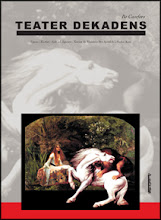
Teater Dekadens

Att lida till lösen för oss andra… Jesusmaterialet som traderats genom årtusendena skär snett in i annorlundaskapets sexuella praktik; sado-masochismens. Att hoppas, hoppas på personen bredvid, var gömmer du piskan? Det har varit en lång dag. Och den rituella speglingen av detta: mässoffret. Offertorium. Offergåvornas tillredelse. Jesus på Golgata - ett djur på väg till slakt. [Det är ståthållare Pilatus soldater som övertar rollen som överstepräster när de torterar Jesus i fängelset. Omedvetna om sin symboliska roll förbereder de jesusköttet med piskan; pryglar det mört.]

[Wikipedia sticker in med en replik: Katolsk teologi talar hellre om kommunion (förening) än om nattvard (måltid).]

UTVIKNING 1:
Jesu lidande i evangelierna; liten guide:
Översteprästerna spottar och slår Jesus (MATT 26:67, MARK 14:65, [Obs: nämns varken hos Lukas eller Johannes) // Pilatus soldater pryglar Jesus (MATT 27:26, MARK 15:15, LUK 22:63) // Pilatus soldater och judarnas män binder Jesus (JOH 18:12) // Soldater örfilar Jesus (JOH: 18:22, 19:3) // Törnekronan fästs på Jesu huvud (MATT 27:29, MARK 15:17, [Obs: nämns ej hos Lukas], JOH: 19:2) // Soldaterna spottar och slår Jesus i huvudet (MATT 27:30, MARK 15:19 [här misshandlas Jesus uttryckligen med en käpp i huvudet]) // Jesus får vin blandat med galla (MATT: 27:34, [Obs: I Markusevangeliet får Jesus vin blandat med myrra]) // Jesu korsfästelse (MARK 15:25, [Obs: I Matteusevangeliet nämns korsfästelsen enbart i imperfektform enligt senaste bibelöversättningen], LUK 22:33, JOH 19:18) // En åskådare ger Jesus att dricka från en svamp indränkt i surt vin (MATT 27:48, MARK 15:36, JOH 19:29) // En soldat sticker sin lans i Jesus sida (JOH 19:14)

ORGIETEATER
Bo Cavefors, denna kropp som trotsar åldrandet och fortsätter vara lika produktiv som alltid; efter ett tusental bokvolymer som förläggare och författare, otaliga artiklar och essäer, de svarta fanorna från tidskrift till bokserie till blogg, materialet som ständigt skrivs om, kommenteras, ges ut på nytt; Cavefors produktion är i sig ett slags Talmud; oupphörligt föremål för revidering och fortsättning. Kommentar på kommentar. En världsåskådning måste ha sina helgon och visst går det att betrakta Cavefors verksamhet som teater/performanceartist de senaste åren som ett konsekvent praktiserande av filosofierna hos Cavefors egen helgonskara: Yukio Mishima, Francis Bacon, Markisen de Sade, Georges Bataille för att nämna de mest uppenbara och frekventa i hans litterära verksamhet. Verket Three studies for a crucifixion. A Passion Play in Three Acts; dedicated to Francis Bacon av Cavefors och
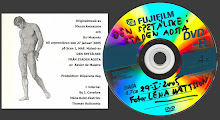
Martin Bladh finns nu utgivet som dvd på Firework Edition.

“Varför inte vilja leva i Dionysos orgiastiska orgasmer?” skriver Cavefors i Svarta Fanor - sjunde boken. “För en ny teaterkonst krävs nya renässansdramer i mörka färger, rituellt formade skeenden som frigör aktiviteter som leder till extrem tillfredställelse över att Vara, över det sado-masochistiska orgiebehovet, tex kring oidipusmotivet.” Three studies… tar sin utgångspunkt i triptyken
Three Studies for Figures at the Base of a Crucifixion av Francis Bacon. Tavlorna har var och en tilldelats varsin akt och under föreställningen projiceras Bacons förvridna människogestalter på väggen bakom aktörerna. Dessa Bacons söndermalda kroppar, ofta ansiktslösa, deformerade, förvridna och vridande, roterande kring sina egna smärtaxlar. Inte sällan inhämtades inspirationen från slakterier. Det är smärta i minst fyra dimensioner målade i olja och sand.

I verkets andra akt ligger Martin Bladh på en enkel säng i scenens mitt med stinkande avföringsfyllda inälvor över sig. En man i skyddsdräkt stoppar en gummislang i Bladhs mun och ger honom blod att dricka från tio behållare (sammanlagt fem liter blod). En behållare i taget. Och efter varje behållare skrubbas munnen med en vinägerindränkt svamp (se guide till Jesu lidande ovan). Under “riten” ses Cavefors och “The Whip Man” (Johan Adolphi) kopulera till höger om sängen och till vänster om den ses “The Naked Man” (Jakob Ohlin) följa processen som en tillbedjare vid korset. Noisedrone signerad Bladh och Erik Jarl (veteraner i noisescenen) fyller altarrummet samtidigt som Bladh häver ur sig blodet i vilda kaskader över sig själv och scenen.


Det är svårt att tala om Cavefors och Bladhs verk med koncentrationen i behåll. Verket skickar associationsbanorna i så många riktningar på samma gång; samtidigt som de omväxlande lustbetonade och horribla (det är förstås ointressant för de inblandade att dra gränslinjer mellan de två) handlingarna på scenen skickar signaler genom mig som är långt ifrån begränsade till det reflekterande sinnet. Nej, det hör till den teater som tar riten på allvar att tala direkt till kroppen. Att tala till kroppen är att tala till förgängelsen. Den egna förgängelsen och privata döden aktualiseras och det kunde lika gärna vara min egen kropp i form av slaktavfall som projiceras på väggen bakom scenen. Francis Bacon citeras i programbladet till dvd:n: “Well, of course, we are meat, we are potential carcasses. If I go into a butcher’s shop I always think it’s surprising that I wasn’t there instead of the animal.”

Associationer. Nej snarare våldsamma svallvågor. Verket sköljer över mig i den bekväma soffan. Dionysos, Jesu korsfästelse, Jack the Rippers sista och mest våldsamma slakt av Mary Kelly, rester av kollektiva minnen jag inte ens visste jag hade, orgasmen… Verket lyckas på något sätt göra EN lust av tre begär; begäret efter piskan, nattvarden och könsumgänget.

Det är en teaterkonst som jag inte trodde existera den här sidan om sextiotalet eller Östersjön (nere på kontinenten hägrar
Hermann Nitsch). Som jag inte vågat hoppas på att få ta del av i den desinficerade och glittrande kroppslösa samtiden; som har städat bort döden och i förlängningen möjligheten till en verklig närvaro i livet.

UTVIKNING 2:
Teater Dekadens ger kroppen tillbaka till kroppen. Vi lever visserligen i en kropps- och sexfixerad värld, men knappast en sexintensifierad värld. Orgasmen (en distanserad, sekundkort liten prutt till njutning) har ersatt Gud, orgien (=föreningen) ska leda oss tillbaka till Gud. Och i samma rörelse till förgängelsen, och en kropp som tillåts lukta, läcka, och njuta av sin egen späkning. Ledorden för den här formen av teater skulle kunna vara KOMMUNION GENOM KONFRONTATION.

Three Studies for a Crucifixion aktualiserar min egen längtan efter riten. Denna kompromisslösa orgieteater ger mig mod att fortsätta inåt. Jag är en sådan periodare i mystiken. Av rädsla för vad? Att mitt intresse för mystiken skall fjärma mig från mina (ateistiskt lagda) vänner? So be it.

Jag hoppas på en höst som pendlar mellan extremer: från tystnad & hunger till orgie & rit. Ge mig fem år så har jag säkert sållat mig till katolikerna.


Copyright©Daniel Westerlund 2008.

Friday, August 22, 2008

Bad Alchemy #59/08 : MARTIN BLADH


Rigo Dittmann
MARTIN BLADH

- - - - -
BA: If You had to go back in time for a ‘Self-portrait of M. B. as a young monkey’ (to steal from another M. B., Michel Butor), when and how did it dawn on You that You are… different, maudit, an - artist?

MB: When I passed on from being a mere listener and observer to being creative. At a certain point (probably by the beginning of the millennium) I decided that I didn’t want to dedicate my life to someone else’s work. Certainly, after IRM had recorded Oedipus Dethroned [2000], I thought that I had something going that I wanted to dig deeper into and would take years to exhaust. A couple of years later when I first saw my own vision materialised in the flesh, I got quite exited cause this was an image I’ve been thinking of for years. The action work Sensation is Everything was of great importance to me (although I don’t fashion it as one of my better pieces today).

Mit Bo I. Cavefors (*1935) begegnet einem jemand, der vom Enfant terrible bis zum ‚unwürdigen Greis’ eine gradlinige Biographie des Verfemten vorgelebt hat. Ob als Verleger, Autobiograph oder Essayist, mit Cavefors hat das Heterogene eine erste Adresse in Lund. In den 60er-80er Jahren hatte er unermüdlich anarchische, anrüchige, pataphysische, psychoanalytische und revolutionäre Literatur publiziert (Burroughs, Dali, Jünger, Lautréamont, Mao, Nietzsche, Pasolini, Pound, A. & P. Weiss…), bis der Skandal um RAFTexte zum Bankrott und Schweizer Exil des Verlags führte. Seit den 90ern sorgt er für Skandal mit seiner Textreihe Svarta Fanor, ein Name, in dem neben der Drapeau Noir der Anarchie auch Strindbergs Schwarze Fahnen mitschwingen, und mit dem Teater Dekadens, das Nitschs Mysterientheater abwandelt zu Exerzitien des Verfemten. Ich sage bewusst 'Exerzitien’, denn Ignatius von Loyola ist mit seinem ‚Agere Contra’ ein unwahrscheinlicher, aber wesentlicher Stichwortgeber für Cavefors ‚politische Theologie’. Cavefors‘ ‚unmöglicher’ Horizont, für den man sich hierzulande eine Fusion aus März Verlag und Matthes & Seitz vorstellen müsste, verbindet Ideen der Konservativen Revolution und des Heroischen Nihilismus mit der Spiritualität der Kartäuser und erotischer Verausgabung. Ernst Jüngers‚ Anarch’ (aus Der Waldgang) ist der Heros einer Souveränität, die Carl Schmitts diktatorische Definition ‚Souverän ist, wer über den Ausnahmezustand entscheidet’ (d. h. wer den Notstand ausrufen und mit Polizei und Militär jeden Widerstand platt machen kann) mit Bataille’schen Vorzeichen anarchisch umkehrt: Souverän ist, wer gegen die Normierungsgewalten um jeden Preis seinen persönlichen Ausnahmezustand lebt.

BA: The emphasis on excess and enjoyment at any cost, what You call ‘sexual absolutism’, and the motto: Agere contra (to act against) seem to contradict the ‘desinvoltura’ of Ernst Jünger’s ‘Anark’, another heroic model of Yours, whose attitude is to resist power by ignoring it?

MB: My work is full of contradictions. But I cannot really see the contradiction between the Jüngerian Anark and the supreme libertine. Although I respect Jünger’s work I can’t really say he’s been that influential on my part, the manifesto was written in collaboration with Bo Cavefors. I myself have nurtured a project which I used to call The New Theatre of Cruelty and Bo got his own project called Theatre Decadence. Bo is a huge admirer of Jünger and he was one of the first to introduce his work to the Swedish audience in the sixties. The main reason for quoting him was to illustrate how we don’t care about the political movements of today, and thus through our theatre feel ourselves liberated from them. As stated our agere contra is a very personal one and has nothing to do with a collective utopian following, it has to do with being aware of the world, but ignoring it and thereby act against it; to live inside a society but at the same time be able to live outside of it. I don’t see this as a heroic act but a necessary one. Communication is what it is, and foremost directly related to our own carnal desire, exhibitionism and narcissism, masochism and sadism.
&c. HERE!
- - - - -

Bad Alchemy Magazine
#59/08

Hmmm Dämon - Bidner & Martinek, Meese & Feuerstein (Dämonologische und ludologische Überlegungen); Martin Bladhs Theater der Grausamkeit; Joyful Noise - Taktlos 2008 (von GZ); 25 Jahre 'Musique Action' (von Bernd Weber); Party Intellectuals - Ceramic Dog live; A Potent Brew - Sean Noonan's Brewed By Noon; If You Like Armaggedon - Evangelista (von M. Beck); Veins to the Sky - Alexander Tucker; The Spectres of lost Possibilities - Hauntologische Splitter; Konfrontationen Nickelsdorf 2008 (von R. Gmöhling); Das Pop-Analphabet von Allroh bis Z'ev [nur für Abonnenten: Artwork von MARTIN BLADH]

Bad Alchemy erscheint ca. 2–3 mal jährlich.

Herausgeber: Rigo Dittmann


Tuesday, August 12, 2008

Vital Weekly: "This is the real deep black horror of existence..."


VITAL WEEKLY
number 639
week 33

MARTIN BLADH & BO I CAVEFORS THREE STUDIES FOR A CRUCIFIXION (DVD & CD by FireWork Edition Records)This DVD is of a three act "Passion Play" dedicated to Francis Bacon, this is nothing to do with noise either, but certainly could in no way be described as trivial. The protagonists here in front of a projection of the paintings set out to embody the nihilistic vision of the painter. You might feel disgusted or sick at the blood, intestines and homosexual acts- and perhaps want to return to the playfulness of Fckn'bstrds antics. This is the real deep black horror of existence - shocking in that is can be or should be performed by human beings at all, not that it is in its deliberation - to shock or disgust- that would be too easy, it would become a sex show, and it is not. Like the paintings of Bacon it unfolds along a horrific and deterministic trajectory that somehow cannot be avoided, if it did appear to be deliberately shocking then it would be possible to step outside the drama and see it as amusement or entertainment. Or is it excusable as a sudden outburst of promethian energy - which is understandably human - from tribal dancing through to the silliness in noise festivals. The real horror here is the premeditated logic of the performance devoid of any emotional excuse. This performance as also Bacons' paintings in their inhumanity could and should be ignored as impossible imaginations if not for the reality of the logic of the slaughter house from which they derive and the even more terrible realizations of these artists finding in this beauty. (jliat)

Address to Firework here!

Monday, June 23, 2008

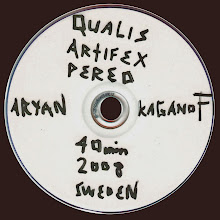
qualis artifex pereo

'
'


african noise foundation
in association with
grymhetens teater dekadens
present
"qualis artifex pereo"
("oh what an artist the world loses in me"
emperor nero’s dying words upon committing suicide)
an acéphale performance
by
bo i. cavefors, johanna rosenqvist, martin bladh...
text by georges bataille and martin bladh
music composed by
martin bladh

sound engineer mikael oretoft
film aryan kaganof


(40min, HDV, Sweden, june 2008)


Info 1.


Info 2.


Info 3.

Wednesday, May 21, 2008

THREE STUDIES FOR A CRUCIFIXION DEDICATED TO FRANCIS BACON

'
'
Martin Bladh & Bo I. Cavefors
presents
THREE STUDIES FOR
A CRUCIFIXION;
a Passion Play in Three Acts;
dedicated to FRANCIS BACON
dvd video 60 minutes
cd audio 50 minutes
12 page booklet
'

Sunday, March 16, 2008

INFORMATION - ACTION NO.4 / The Miracle


'
'
The monologue The Miracle (Miraklet) by Bo I. Cavefors
is a part of Act One of Martin Bladh’s & Bo I. Cavefors’ Action Francis Bacon. Three Studies for a Crusifixion; a Passion Play in three Acts; dedicated to Francis Bacon.

Actors: Johan Adolphi / Martin Bladh / Bo I. Cavefors / Jacob Ohlin / Mikael Oretoft.
Photographers: Peter Andersson and Lars Bosma.
Music: Martin Bladh and Erik Jarl.
Dvd + cd published in April 2008 by Firework Edition Records
.
+
+ + +
Bo I. Cavefors
THE MIRACLE

I will tell you a story. Once upon a time, about two hundred years ago. The story takes place in a little town in north Italy, in Piemonte. In the outskirts of the town there was an old marble tower. There the authorities had placed a leprous man and his sister, who was also a leper. The sister died. The leprous man felt ashamed of his sickness, although the upholders of the law claimed that all shame had been extinct, that no one had anything to be ashamed of anymore. The Leper though about killing himself, but the fear of God’s wrath prevented him. So, by mere chance the Leper was saved from eternal damnation. During the days the leper meditated, admired the roses his sister had planted, enjoyed the beautiful view of the valley and the town in the distance. The only company the Leper enjoyed was during those rare occasions when a traveller stopped by, and from a safe distance, spoke with him.

No, it wasn’t really that bad. A little dog had joined the Leper. Why the dog had sought sanctuary at the Leper’s side no one knows. The leper claimed that it might be because the dog was as ugly as himself. The dog had been thrown out, and had also been rejected by the people, which had terrorised it, harassed it, bad-mouthed and taunt it. But to the Leper the dog was worth its weight in gold. Out of gratitude of the mercy God had showed by giving him the dog, the Leper called him the Miracle. A rather awkward name for such an ugly dog. A mongrel, tangled, limp, dirty. A bastard. A bastard.

But the Miracle was like every other male dog. Sometimes he escaped to the town in the valley. Away from the Leper in his marble tower. What was the Miracle doing there? He did what every other male dog who sought freedom does. He was fucking. Preferably other male dogs. The Miracle lived the same life of transgression which Gombrowicz speaks about in his books, especially in his memoirs. And which the painter Francis Bacon depicts in his religious paintings of men making love. Men making love, but always in the presence of God. The Miracle was hovering between the safety, the meditative stillness, love and gloominess of the Leper in his square shaped tower of white marble, and the wild and swinging sexuality that was practised in the parks and backyards of the town. Some of the town citizens, embittered revolutionaries, became upset, indignant of the Miracle’s freedom, and filled an acclaim of his behaviour to the town council, they wrote long letters to the local newspaper and announced a petition to get the Miracle out of the town. Shouting: get the Miracle out of this town! But the Miracle wasn’t just limp and crippled and a dirty bastard, his hearing wasn’t very good either. So the Miracle stayed in the parks and backyards as long as he dared to before he finally was forced to seek shelter in the Leper’s tower. Later on the aggravated moralists claims that they didn’t want to get rid of the Miracle because he was a dog, but because they were afraid that he was spreading an infection, that the Leper’s disease could spread from the Miracle to the town citizens. But all these explanations were nothing more than excuses. The truth is that their anger was nothing more then pure jealousy directed towards the Miracle’s anarchistic freedom. They said that the Miracle should be ashamed. Ashamed of what?

These moralists had a couple of years earlier like French revolutionaries marched under the banners and craved for liberté, fraternité and l’amour. Now, united together for a mutual attack against the Miracle’s freedom. They paid there respect to the town commandant, who was depending on the citizen’s loyalty and tax revenues. The commandant gave an order that the Miracle should be put to death, to be killed, immediately. A couple of soldiers accompanied by these moralising citizens went up to the Leper’s tower to execute the cruel order. The soldiers ordered the Leper to surrender the Miracle to them. They referred to some section of a law that states: it is forbidden to hide fucking dogs. They could be disease carriers. In the presence of the Leper they fetched a heavy rope around the Miracle’s neck and dragged him along with them. When the soldiers, the lynch-mob and the Miracle passed the gate in the wall that surrounded the white marble tower, the Miracle turns around and looks back at the Leper with helpless, begging eyes. But the Leper doesn’t do anything to help or try to save his friend… The soldiers’ intention was to drown the Miracle in the river that runs through the valley, but the mob were already there when they arrived, the rabble, the bourgeois traitors were already there carrying rocks in their hands and they killed the Miracle with these rocks. The Miracle was stoned to death. The Leper could hear his friend’s cry. But he returned to his cell in the marble tower. His trembling knees could hardly hold him up. He throws himself on the bed. Shed some tears. OK. For the second time this day he betrayed the Miracle. Later on the Leper claims that he, in the order to execute the dog can’t see anything but the cruel moralising and the barbarisms of the authority in charge. But the Leper doesn’t realise, he might not even suspect that the Miracle was only the first victim, and that he himself, the Leper, could be the next victim and then follows victim after victim after victim of deviants who do not fit into the aggravated citizens - in the new moralists and the authorities’ normative hysteria. These dissidents are growing tumours in the body of society. Maybe the fags want to rape the animals, cute little puppets. How do we make action out of words? How do we remove these tumours? Through decapitation or the electric chair, like in Texas? With rat poison? The Leper himself became a victim of this mass hysteria, of this immoral morality which is being preached by newspaper journalists, preachers and neo-Nazis, when he later says that he is ashamed of his sentimentality. Ashamed, ashamed! Ashamed of his sentimentality! Ashamed of the shame of being born…


Translation by Martin Bladh.
Actors on the Photo: Bo I. Cavefors and Johan Adolphi.

Copyright©text:Bo I. Cavefors and Martin Bladh 2005, 2006, 2007, 2008.
Copyright©photographs:Peter Andersson and Lars Bosma 2007, 2008.

Saturday, March 15, 2008

INFORMATION - ACTION NO.3 / Revolt in the Kasbah


Martin Bladh & Bo I. Cavefors Francis Bacon. A Passionplay in three acts related to Three Studies for a Crucifixion by Francis Bacon

From the third act:
Revolt in the Kasbah by Bo I. Cavefors

The empire of the great moguls were stronger then ever: immoral power had been transformed into morality, ethic replaced by rhetoric. The freedom being degraded into the right of being supervised and the society was ruled by two classes, the ruling class and the classless ones that didn’t even have any mutual belonging.

Only true moral can replace the morality and join the classless ones in the struggle against the immorality which the great moguls proclaim as morality, where the unwillingness towards humanity was clouded by a shameless exposing of pitiless humanism. In a situation like this the Kasbah has to be liberated and the beige clad people delivered to be united with the classless ones, the outcasts, so that love becomes love, my brother my brother, my sister my sister.

The banners of the revolution are fluttering and the charismatic, flexible, young tiger leads the army of the infected and unwanted towards victory. When the sun rises in the east, when a new day dawns after the night has been endured, he brings together aids victims, blackheads, skinheads, disabled and cripples, Jews and Arabs, excluded bureaucrats, starving seniors, fools and terrorists, unemployed tiger cubs and all those that’s have been hidden behind the training suits body armour. There he stands; legs wide apart, jeans unzipped; pulled down, caressing his yellow brown thighs, stretching his beautiful cock, exposing the solid ribcage, giving the word for departure.

With twigs thrashing their backs, the leather straps flogging their naked buttocks, following the intense bellow of trumpets the crowd of flagellants march through the Kasbah gates. Wearing fool’s motleys, with nails and lips tarnished in black, with green eyelids, with rings in their ears and around their ankles, with hair flaming in all the colours of the rainbow, with moist wide open vulvas filled to the brim with lingonberry sprigs and blossoming heather, with beauteous cocks which heads are swollen as mellow blue plums, tempting every famished bird to pick its beak bloody. The army of the tiger marches out of the city, over the meadows, through the forests, away from society’s tentacles, escaping the politicians purging bath of rosary water and she-ass milk. They leave the society that denounce them, that reject them, and through organised debauchery experience a new night’s ecstasy, where sublimation is replaced by orgasms as mighty as the cock in the same moment the juice gushes out to flood swollen lips.
What can police and security companies, great moguls, rubber batons, teargas and water canons do against an army of sufferers, where every new affliction increases the ecstasy, makes the pain more sweeter, when death delivers and collective dying reconciles.

The Marquise de Sade speaks about a must which shock civil masochists, but is it not these tears of passion that make extremely good excesses grow.

Actors on the Photo: Bo I. Cavefors and Johan Adolphi.


Translation by Martin Bladh

Francis Bacon. A Passionplay in three acts related to Three Studies for a Crucifixion by Francis Bacon©Martin Bladh&Bo I. Cavefors, 2007, 2008.
Copyright©photographs:Peter Andersson and Lars Bosma 2007, 2008.

Thursday, October 25, 2007

INFORMATION - ACTION NO.2


'

''

'

'

'

'

'

Action


Martin Bladh &

Bo I. Cavefors
´'

Francis Bacon

A Passionplay in three acts related to Three Studies for a Crucifixion by Francis Bacon

Actors:

Martin Bladh / Bo I. Cavefors / Johan Adolphi / Jacob Ohlin / Mikael Oretoft

More pictures from the performance at Fylkingen, Stockholm 070909:

Act 1

Act 2

Act 3

'

'

Wednesday, August 29, 2007

INFORMATION - ACTION NO.1


THE NEW THEATRE OF CRUELTY has a constant discourse with the universal theme violence-sex-death-cruelty, and THEATRE DECADENCE expose the possibilities of agere contra as an answer of the norm-terrorism. agere contra: break off the foundationalism of uniformity and release the traditions from the ancient Greeks, from Romans of the Roman Empire, from the equestrians of Middle Ages and from the decadency of to-day. Non-norms are, that’s our belief, the normal-reality and the norms are the real morbid, hokey, obtruded, the non-worthy. Howe’er, our actions are no and never outcries against the norm-society and it’s seers; we waive face-downs. We have no political declarations. We manifest how the abasement can be handled when we convert it to enjoyment and sexual absolutism and exhibitionism and a strict acceptation of it’s most profounded consequences, sperm, blood, whips. + + + Our first action/performance, related to Francis Bacon, Three Studies for a crucifixion, is followed by actions about the Roman paederast Heliogabalus and Gilles de Rais, the mediavel-boylover, the virtiuoso and aesthetican. An eon of twothousand years shall be visualized: how rites and Eucharistic adoration are transfigured in the flight of time, but still are ageless: Dionysiac indulgence, body and sex, distress, the surrender, blood and hangmen. + + + Ernst Jünger mention the “anark”, the man who smash the power in ignoring it, an individual resigning the normal. That’s our position. As Jean Genet said: “If our theatre stink it’s because all other plays stink good”. + + + Martin Bladh / Bo I. Cavefors


Sunday, May 20, 2007

Saturday, October 07, 2006

ABOUT BO CAVEFORS by LEIF ERIKSSON


(The essay accompanying this CD was published in the run-up to an exhibition about Bo Cavefors, which was to be shown at Vita Kuben, part of Norrlandsoperan in Umeå, Sweden, between November 9 and December 4 2002. The exhibition had been put together by the Sons of God – Leif Elggren and Kent Tankred –, but was cancelled by Lars Sahlin, the local curator, on the eve of its opening. At the same time, my essay was removed from Norrlandsoperan’s website. Two flagrant acts of censorship that occurred on the anniversary of the Kristallnacht, November 9 1938. Leif Eriksson, January 31, 2003)


Leif Eriksson


ABOUT BO CAVEFORS

Signs in the sky

The light from a black bulb is also bright!
It just takes longer before you see it!

The analogy is with the eclipse.


Total solar eclipses occur with precise regularity. Everything stops, the birds fall silent, but our hearts beat on and suddenly it is evening. In the winter of 1979, darkness descended on Bo Cavefors’s publishing firm in Sandgatan, Lund, Sweden.

The corona ruined eyes. The smoked-glass eyepieces weren’t dark enough and left many people blind.


A serious disorder for those that would see. Thanks to the solar eclipse, we now know that space curves.


And others know more than they did.


Seen in such a compressed perspective, most things appear inessential, meaningless, even for a publisher.


But articles of the law, mucky bureaucracy and imbecility conspired to snuff out a unique publishing business.

This deplorable chapter of Swedish publishing history is still waiting to be properly chronicled. When will some postgraduate student lay claim to and explore this important area? It is a subject for several departments, eg literature, law, art history – not to mention all those students within the world of bookselling and libraries.

In contrast with the black, is the white more visible, or is it the other way around? You decide!

At the local level, ie Sweden, the eclipse became permanent. Human conventions and taboos played the major roles. Are we ourselves to blame for this state of affairs?

To be remembered for works done with a complete belief in the freedom of expression, regardless of creed, is reasonable. Plurality and free expression are things that everyone should strive for, since they mean freedom and the possibility to say that which can and must be formulated. Utopian thought.

On a primitive level, even the noblest aims can be ruined by narrow preferences and informal loyalties, not least liberal ones like the symbiosis between Lennart Eliasson, a public prosecutor, and Birgit Rodhe, then chair of the National Council for Cultural Affairs. He ordered humiliating searches to be made in Cavefors’s office and home, and kept him in custody for nine days, all according to the rules, but gained nothing of note in the end. Cavefors was only convicted of sloppy bookkeeping, and fined. And she nullified – with a stroke of her pen – Cavefors’s biggest publishing project, the Strindberg edition. Why?

Can these injustices be put right?

The exhibition in Vita Kuben at Norrlandsoperan, Umeå, Sweden, will present all 820 titles published by Bo Cavefors since 1959.

It began in 1959 with Brendan Behan’s play ”The Quare Fellow”, a tragicomedy, translated by Mario Grut. Behan’s ”The Hostage” was also published that year. Fateful titles, in retrospect. (Translator’s note: ”The Quare Fellow” was published as ”Den Dödsdömde”, or ”the condemned man”.)


As for the work to do with the publishing, Bo Cavefors ran a one-man show – though he did have four employees during the last four years.

During the two decades that his firm was in business, he achieved more than any other publishing house in Sweden in terms of selecting writers and works.

Frequently they were controversial writers, eg Ezra Pound or Ernst Jünger, but there was also other explosive political and philosophical writing by Marx, Engels, Lenin, Stalin and Mao, and texts
such as ”Der RAF” [Rote Armé Fraktion].


It was probably that last title which clinched his judgement.


Not officially. Repressive tolerance had worked until then, but supporting terrorists? No, there are limits to the freedom of the press.


For Cavefors, freedom of expression still applies!

Allowing difficult and locally unknown writers to make their voices heard in Sweden was clearly too much.

Anyone who looks at the publisher’s last printed catalogue, with illustrations by Carsten Regild, a Danish-Swedish artist (1941-1992) – including, on the cover, his

congenial black light bulb (1978) which also illustrates my article, albeit turned upside down –, as well as a later supplement, is likely to marvel at its enormous variety and distinctiveness.

No other publisher in Sweden has achieved anything like it. The most important title is probably the one that never got published, but those that did get published highlight that important time now past, which – and that´s the scandal – clearly hasn’t become an accepted part of the historical flow.

Few contribute to radical knowledge and renewal.

The fear of new and different things is great.


Those who dare end get into the biggest trouble.

They are made to stand in the official cultural corner of shame, and punished for that ”widely accepted freedom of expression”.


Much energy is spent on cheating death; less on values, backbone, and on defending the particular.

It’s surprising, really.

Humanity is incredibly complacent and gullible that way.

Cavefors was not averse to any subject, any writer – as long as the manuscript was good. When I asked him why he published so many titles by Alexander Weiss, he replied laconically: ”I thought they were good”.

Anyone who wants to know more about what happened in the winter of 1979-1980 can read the exhibition’s facsimile of arts editor Nils Gunnar Nilsson’s articles in Sydsvenska Dagbladet, dated March 10 and April 13 1980.

Bo Cavefors himself has talked about what happened in an interview with Arne König and Lasse Winkler, published in Svensk Bokhandel, a booksellers’ trade journal (”Lundaförlagen, Cavefors ande vilar över Lund”, Svensk Bokhandel, 1997, no.2, pp. 13-26).

And for anyone who wants to know more about Bo Cavefors and about how it all started, I recommend two of his three books: ”Barnsliga memoarer” (”Childish memoirs”) from 1995 and ”Valpen som ung man” (”The whelp as a young man”) from 1996, both printed in Eslöv (the dreariest town in Sweden) and published by Förlaget Svarta Fanor. His other book, ”Helvetet” (”The Hell”), published by writer and editor Eric Fylkeson at Janus Förlag, 1985, is a collection of articles dealing with his Catholic faith and history.
Fylkeson wrote on the dust jacket: ”Cavefors’s contribution as a publisher during the 60s and 70s is legendary. Hundreds of unconventional and inconvenient books were injected into Swedish cultural life”.

Cavefors’s publishing efforts have not gone unnoticed over the years, however.
In his publisher’s archive are more than 20,000 press cuttings of reviews and articles, along with the unique correspondence he had with each of his many writers from around the world.

But when he offered this archive to Lund’s University Library, he was told that it might consider taking a selection.


That bloody well constitutes a breach of duty!

But, in 2004 Lund University, the Centre for languages and literature, acquired Cavefors’ Library and his Archives!


The complete list of publications shows that he published 13 central works by Peter Weiss. And 19 by his brother, Alexander Weiss! It also shows that Stig Claesson published his first book, ”Från nya världen”, with Bo Cavefors in 1961.


Nobel prizewinner Wole Soyinka was published by Cavefors in 1975, before he received the prize.


”Jungfrutro och Dubbelmoral” by Kristina Ahlmark-Michanek, 1962, became one of Cavefors’s top sellers, with five editions until 1963. It sparked the huge debate about sexual hypocrisy in Sweden.

But first something about the cultural context of the 60s, whose first half was marked by Swedish sin and the debate about free sexuality. There were loud and frequent calls for censorship.


Moderna Museet in Stockholm was inaugurated in 1958. A 1961 exhibition called Rörelse i konsten (Movement in Art) contained a work that was banned. It was by R. Müller, and entitled ”The Cyclist’s Widow”.

Its indecency consisted of a white dummy cock that bobbed up and down through a hole in the saddle when the pedals were turned. The great art debate ”Is everything art?” was raging at the time. Film censors were descending on Vilgot Sjöman’s film of Lars Görling’s ”491”. Per Oscarsson nearly showed his dick on Hylands hörna, the most popular family entertainment show on Swedish television in the 60s.

The Zinderman publishing house, in Gothenburg, released ”De erotiska minoriteterna”(”The Erotic Minorities”) by Lars Ullerstam in 1964, shedding light on necrophilia among other things. In 1965, Bengt Forsberg’s house in Malmö began publishing ”Kärleksböckerna” (”The Love Books”), edited by Bengt Anderberg, to great success. Anderberg himself got into trouble as early as 1948, with his first novel ”Kain”. When Pye Engström’s small bronze sculpture of a couple copulating was shown on TV in connection with Multikonst 1967, an art show, there was also an outcry – and the kindred, sorry, hundred couples were immediately sold.


The law against ”harming temperance and morality” reigned.

A number of Swedish artists were subjected to censorship. At Akademiska föreningen in Lund, Bengt Rooke conducted his Sex Evening in 1965: he painted a nude woman, ”who fainted”. Rooke swathed her in a Swedish flag, flung her onto his shoulder, and left. Several-page photo coverage followed in Se magazine, no.38. That provocation cost Rooke his teaching job. That same year (only earlier), Rooke had presented a performance entitled VROOM at Lunds konsthall. According to press reports of the event, it was ”openly pornographic!”.

Sture Johannesson was charged with the above-mentioned offence for having displayed, in the window of his Galleri Cannabis in Malmö, Lars Hillersberg’s scurrilous portrait of Sven Wedén, leader of the liberal People’s Party, trying to make his cock erect with the aid of a pair of pincers made at his tool factory in Eskilstuna. Hillersberg wanted to be prosecuted, see PUSS no.3 1968; Johannesson was, but was acquitted. PUSS, which published 24 issues between 1968 and 1974, was an incredibly important and provocative magazine, without parallel in Swedish periodical literature.

The May revolt of 1968 showed that the younger generation was politically aware. Flower Power and Hippies, ”make love not war” and the drug culture flourished, as did the Vietnam movement with its many demonstrations against America’s war in Vietnam – to which the police responded with brutality.

There were several scandals at Galleri Karlsson in Stockholm. The inaugural exhibition of Ture Sjölander’s pictures, ”Ni är fotograferad” (”You are being photographed”), showed a pair of naked ladies in the window, and TV and migration followed. At the same gallery, poet and artist Jarl Hammarberg showed his handwritten poster ”VÄGRA VAPEN VÄGRA VÄRNPLIKT” (”Refuse weapons refuse conscription”), in 1967. The prosecutor deemed it an incitement to rebellion, and Hammarberg was fined. When Carl Johan de Geer exhibited his three 1967 serigraphs, ”USA mördare” (”USA murderers”, with an American flag whose stars had been substituted for swastikas), ”Vägra vapen, vägra mörda, vägra mördas, svik fosterlandet, var onationell” (”Refuse weapons, refuse murder, refuse being murdered, betray your country, be un-national”), and ”Skända flaggan, Vägra vapen, Kuken” (”Desecrate the flag, Refuse weapons, The cock”), the editions were seized and destroyed after a guilty verdict in the court of appeal. See PUSS no.7, 1968.

Director Folke Edwards was fired from Lunds konsthall in 1969. He had mounted two important exhibitions, ”De otäcka” and ”Erotic Art”, but perhaps the main reason was that he had commissioned a poster for the ”Underground 1969” show, whose correct title was ”Revolution means revolutionary consciousness”, by Sture Johannesson. The ”hash propaganda” of the poster was the last straw for Konsthallen’s board, who stopped the show and forced Folke Edwards to resign.

In Uppsala in 1965, I was present when the police seized ”Man i bur, bekännelse av en homosexuell” (”Caged man, confession of a homosexual”), by Christoffer Palem (a pseudonym), because it had been deemed pornographic.
It was later allowed back on bookshelves after a court acquittal.
The law about harming temperance and morality was eventually scrapped.

Cavefors’s publishing comprises a wide range of titles. The following is a selection of authors, listed alphabetically.

Hans Arp, Fågel och Slips, translated by Benkt-Erik Hedin and Bengt Höglund, 1961.
Roland Barthes, four titles 1966-1975, Litteraturens nollpunkt, Kritiska essäer, Mytologier, S/Z.
Walter Benjamin, Bild och dialektik, 1969.
Hermann Broch, Vergilii död, 1969.


William Burroughs, Den nakna lunchen, translated by Peter Stewart, 1978.
Rolf Börjlind, Persona non grata, 1977.
Fredrik Böök, Kritiskt bokslut, 1976.
Pierre Cabanne, Dialog med Marcel Duchamp, translated by Jan Östergren, 1977.
Eight titles by Stig Claesson.
Three volumes by Maurice Cornforth, Marxismens filosofi, 1969.
Sture Dahlström, Gökmannen, 1975 and Den galopperande svensken, 1977.
Salvador Dali, Salvador Dalis hemliga liv, four editions 1961-1973.
Isidore Ducasse, Greve Lautrémont, Maldorors sånger, translated by Carl-Henning Wijkmark, illustrated by Ragnar von Holten, 1972.
Bob Dylan, sånger i urval, translated by Bruno K. Öijer and Eric Fylkeson, illustrated by Leif Elggren, 1975.
Umberto Eco, Den frånvarande strukturen, translated by Estrid Tenggren, 1971.
Leif Elggren, Nervsystem, 19 etchings. Accompanying text by Eric Fylkeson, 1976.
Michel Foucault, Vetandets arkeologi, translated by C. G. Bjurström, 1972.
Gunnar Fredriksson, Det politiska språket, six editions 1962-1974.
Ernesto Che Guevara, Gerillakrig, 1968.
Hilding Hagberg, Röd bok om svart tid, 1966.
Viveka Heyman, Jesajas bok, 1977.
Ragnar von Holten, Jolifanto Bambla, 1976.

Alfred Jarry, Kung Ubu (Ubu Roi), 1963.
Jorden och döden, Italian poetry. Selected and translated by Estrid Tenggren, 1961.

Ernst Jünger, Psykonauterna, and other titles.

Harry Järv, Die Kafka-Litteratur, Eine bibliographie, 1961.
Kim Il Sung, För en fredlig och självständig återförening av Korea, 1974.

Konsten att väcka förargelse. An anthology compiled by Ingemar Hedenius ,1964.
Kvinnan och revolutionen, texter om 200 års kamp för kvinnlig frigörelse. An anthology compiled by Folke Schimanski, 1972.

Claude Lévi-Strauss/Edmund/Guy Dumur, Claude Levi-Strauss och strukturalismen, 1969.
Georg Lukács, Historia och klassmedvetande, 1971.
Rosa Luxemburg, Jag var, jag är, jag blir, 1966.
Man Ray, Självporträtt, 1976.
Karl Marx, Kapitalet, first, second and third volumes 1971, 1973, 1974.
Ulrike Meinhof, Ulrike Meinhofs förbjudna tänkesätt, 1976.
Thomas Millroth, Maktens pyramider, 1976.

Friedrich Nietzsche, Sålunda talade Zarathustra/Sju ensamheter, 1970.
George Orwell, Essäer, selected and introduced by Olof Lagercrantz, 1970.
Pier Paolo Pasolini, Vittnet, 1978.
Patafysisk antologi, edited by Claes Hylinger, 1973.


15 titles by Ezra Pound from 1959 to 1982.
Leon Rappaport, Determinantan, 1978.
Bertrand Russel, Strid för freden, 1967.
Sigmund Freud - Psykoanalysens skapare, Liv och personlighet. Eyewitness stories, 1977.
C.P.Snow, De två kulturerna, translated by C.A. and Lillemor Wachtmeister, 1961.
Torsten Weimarck, Om konst, 1975.
Jan Östergren, Intervaller & Repriser, 1974.


William Carlos Williams, Gary Snyder, Henry James, William Burroughs, Eric Hermelin...

The distribution system used by the publisher changed over the years. Originally, Cavefors had used the old commission system, which meant that every bookshop in the country received one copy of every new book, which they then either accounted for at the end of the year or returned unsold. When this system ceased, Cavefors invented his own system. He gave a free copy to all booksellers who paid the full ”publisher’s price” (excluding sales tax and delivery costs) for one copy. That way, he got two copies out instead of one. He had agreements with about 150 booksellers country-wide. His books proved to be sought-after, and sold. Eventually he created another system for marketing and selling, not unlike those used by IKEA and mail-order companies. He presented his latest publications in regularly printed catalogues. At one point, more than 40,000 catalogues were being sent out to the members of the book club.

A more unusual form of publishing, not controversial but rather experimental, is Cavefors’s publication of artists’ books, in which the page is described ”as an alternative space”, ie used by the artist as a medium. These types of editions are not like those books of art which have to do mainly with the craft of making books. Artists’ books may sometimes look like normal books, but they are essentially idea-based art.

Here, Cavefors was a pioneer in Swedish publishing. As early as 1965 he published ”I PÅSEN” (”In the bag”), an artwork in a carrier bag and an example of Berndt Pettersson’s word and language art, published in connection with his exhibition at Galleri Karlsson in Stockholm, in 1965.


Other artists’ books would follow. They included Sture Johannesson’s ”S. K. O. en vetenskaplig dokumentation med fotnötter”, 1975 (”S.H.O.E. a scientific documentation with footnotes”). It contained full-page pictures of famous artists’ shoes.
Mats B’s Vet snut hut, vett snutt hutt, 1975.
Vita djuret by Peter Ortman and Ola Billgren, 1977.
Rolf Börjlind’s Persona Non Grata, 1977.
Carsten Regild’s Lupus Ultra, 1980. It was set to be published, but Lennart Eliasson intervened, so it was published by Regild’s own firm, Vargen, Stockholm 1980.

The graphic design of Cavefors’s books differed from that of other publishers. During the early years, this difference was of both format and cover. None of the books he himself designed say so. ”I didn’t want to parade my name in every book. It seemed exaggerated, as my name was used in the publisher’s name”, he said in response to my question about why he hadn’t included himself.
All other designers were credited.

The design aspect of his books was observed by Svensk Bokkonst, an institution that each year selects the 25 most beautiful Swedish publications, as early as 1961. That year, Cavefors received honourable mention for the firm’s publishing as a whole. The jury’s decision was even commented on in the catalogue: ”Equally pleasing is the jury’s decision to emphasise, in the foreword, the qualities of those books submitted by Cavefors publishing”.

Cavefors also got involved in the publishing of Verdandi-Debatt, after he had been approached by Carl-Adam Wachtmeister. Publications in the series included Lars Furhoff’s ”Kommunal skendemokrati” (”Municipal sham democracy”) and Lars Lönnroth’s ”Litteraturforskningens dilemma” (”The dilemma of literature studies”). In order to achieve larger editions, a partnership was initiated with Bokförlaget Prisma in Stockholm. Cavefors realised after a while that the published material was echoing the concerns of liberal social democrats too much, and Prisma carried on alone for a while before the project was abandoned.

Instead, Cavefors started the BOC series with polemical books such as ”Det politiska språket” (”Political language”) by Gunnar Fredriksson, and first editions of philosophical works, including Nietzsche’s ”Sålunda talade Zarathustra” and works by Roland Barthes and Michel Foucault, among others. Works of fiction in this series included books by Stig Claesson and Peter Weiss, and there were political works such as Stalin’s ”Teori och Praktik”.

The Zenith series was a paperback series whose editorial committee was made up of Lund leftists who had actually come from Zenit, a syndicalist periodical. Publications were exclusively in the field of political theory, with authors such as Göran Therborn, Torsten Bergmark and Andre Gunder Frank. In all, 22 volumes were published.

After a long hiatus, Cavefors contributed to the resuscitation of VOX, a literary magazine. This was at the suggestion of Sune Nordgren, and a few volumes were published with him as editor. VOX was the old first-publication magazine that Gleerups started in 1947. Poets Göran Printz-Påhlson, Ingemar Gustafson [Leckius] and Majken Johansson, among many others, published their first work in it.


RADIX magazine appeared in 1978, edited by Harry Järv. From 1980, it was published in Zürich and as of no.1, 1982, Cavefors himself assumed the editorial role.

Since Bo Cavefors Bokförlag went into liquidation, Cavefors has continued to publish books. This has been through his Verlag Bo Cavefors in Zürich, which he established back in 1977, before the solar eclipse in Lund. Here he published German editions of Wijkmark’s ”Die Jäger von Karinhall” and Wole Soyinka’s ”Der Mann ist Tot”, among others, as well as the RAF books, which probably caused some irritation among his persecutors in Sweden.


The basic idea behind the Zürich firm was to make use of the rights to editions in other languages, such as German, French and Italian. It was a good idea which never came to be realised. The Zürich firm did publish Ezra Pound’s ”Gajd till Kulchur”, with two titles actually, the Swedish one being ”Gajd till kultuuren” due to the rather intricate original title. The Zürich books were both in Swedish and German, in other words. Pound’s ”Homage to Sextus Propertius” was published by Bo Cavefors Verlag in Merano in 1982. The Zürich firm also published original editions of Jesuit writing, including works by Karl Rahner SJ and notably by Carlo Maria Martini SJ, Cardinal and Archbishop of Milan, whose publications were a great success.


The publishing firm of Näktergalen (Nightingale), in Verona, published four new volumes of Johannes Bobrowski, Roland Barthes, George Darien and Eric Hermelin.

In his vast and varied publishing achievement, Bo Cavefors’s passion for books, reading and writing is best expressed by the small, very carefully chosen and beautiful publications in his ”waistcoat-pocket books” series. These are personal, sometimes deeply private, but above all very honest, straightforward and surprising books. Some examples of the more than 200 titles to emerge from his workshop: ”En Kartusians dikter” (”Poems of a Carthusian”), ”Kartusiansk mystik” (”Carthusian Mysticism”), Ignatian texts, his own translations of poetry and his own texts such as the autobiographical ones, not included in the already mentioned books from 1995 and 1996. (Recordings of his own readings of the two aforementioned [Barnsliga memoarer and Valpen som ung man] books will be available for listening during the exhibition.)

I have become particularly attached to certain editions. These are the ones in which he reveals what are for me poignant fates and unknown contexts. It might be about Wilhelm Waiblinger, the genius, or about T.E. Lawrence (Lawrence of Arabia), or about Pier Paolo Pasolini, which was the last edition, in four volumes. They wore blood-red covers, and under the black band a letter had been inserted in which he writes, ”…but the attached work is, most likely, the last edition from Waistcoat-pocket Books, for the simple reason that the venture doesn’t amuse me any more.” Bo Cavefors.


One thing is very clear: Bo Cavefors is a brave publisher and human being, and not one of those who was blinded when the eclipse plunged Lund into darkness.

The best example of this is the fact that he continues to publish his own magazine, Svarta


Fanor [Black Standards]. The first issue was published in May 1994, and most people choked on it! The printed edition ceased with the triple issue no.16-17-18, 1995. It is now published as an e-mail newsletter with almost 600 subscribers – most of them voluntary!!

Artists Leif Elggren and Kent Tankred are the creators of this important exhibition in Vita Kuben at Norrlandsoperan in Umeå. It opens on November 9 2002 and will close after December 4. The exhibition is available to the public during Norrlandsoperan’s opening hours.


(Translation by Tomas Tranæus)


Copyright©Leif Eriksson 2004, 2006